AI Cheating Lawsuits Tracker — Every Case, Who Won (2026)
What You Should Know
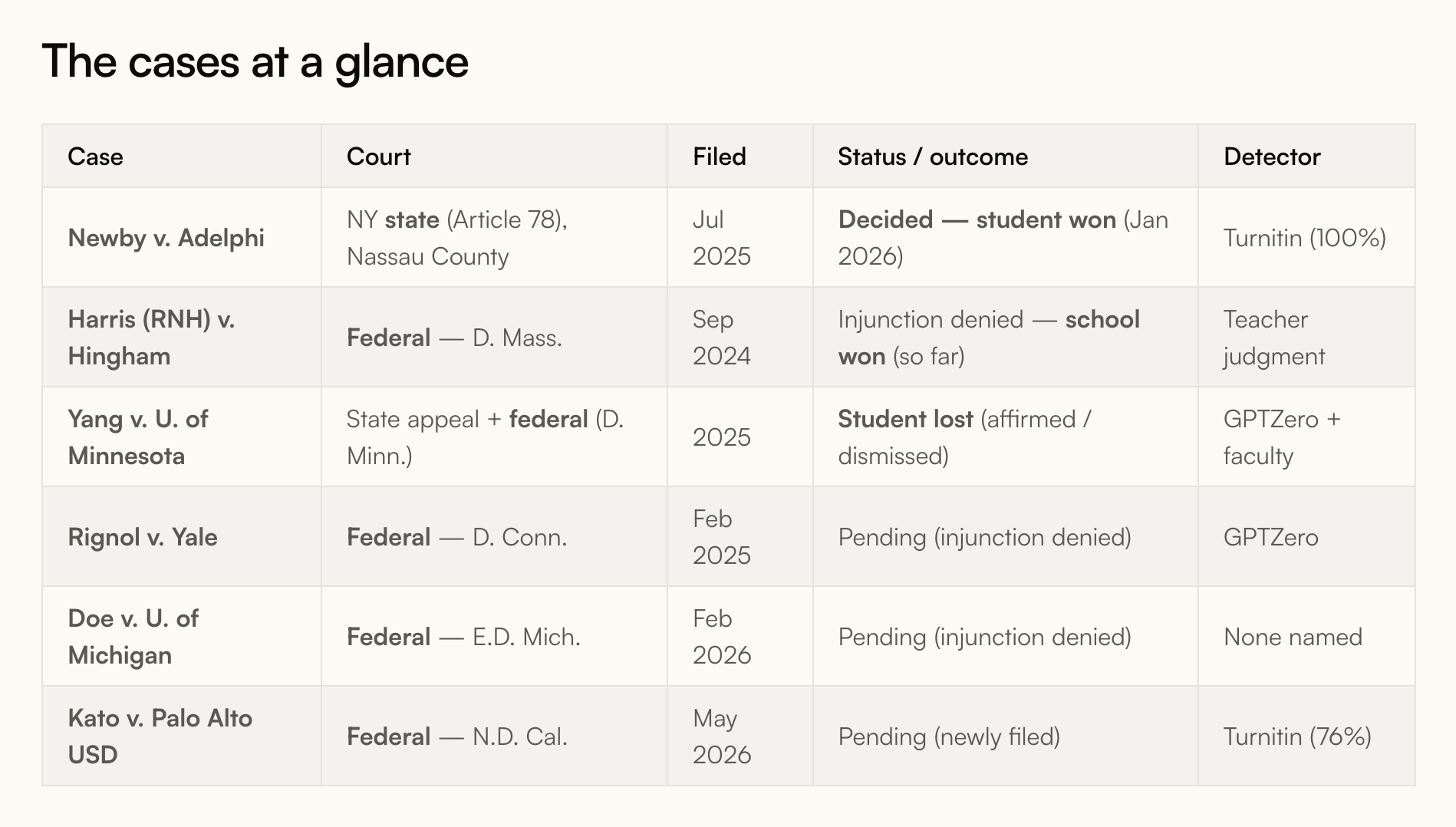
Students accused of AI misconduct are increasingly challenging those accusations in court. GradPilot’s tracker identifies six U.S. cases involving AI-detection accusations: one student has won, two cases have favored schools, and three remain pending. Notably, the cases so far have centered less on whether AI detectors are accurate and more on whether institutions followed a fair process when making and investigating accusations.
Why should educators care? AI detection shouldn’t be the starting point for determining whether a student’s work is their own. Institutions need a better way to understand the writing process before an accusation is made. Typerighter provides that transparency through version history, AI-use history, authorship, and externally pasted content—giving students a record of their work and giving instructors meaningful evidence to evaluate it fairly.
Students accused of using AI by a detector are starting to fight back in court. The coverage is scattered across one-off news stories—and the few "trackers" that exist get basic facts wrong (one popular aggregator labels its whole table "federal cases" when the most famous student win was a state proceeding).
This is a neutral, primary-source tracker of every US lawsuit we can verify where a student was accused of AI misconduct off the back of a detector. We label each by court, posture, and outcome, with docket numbers, and we update it as cases move. [Read the full article.]